
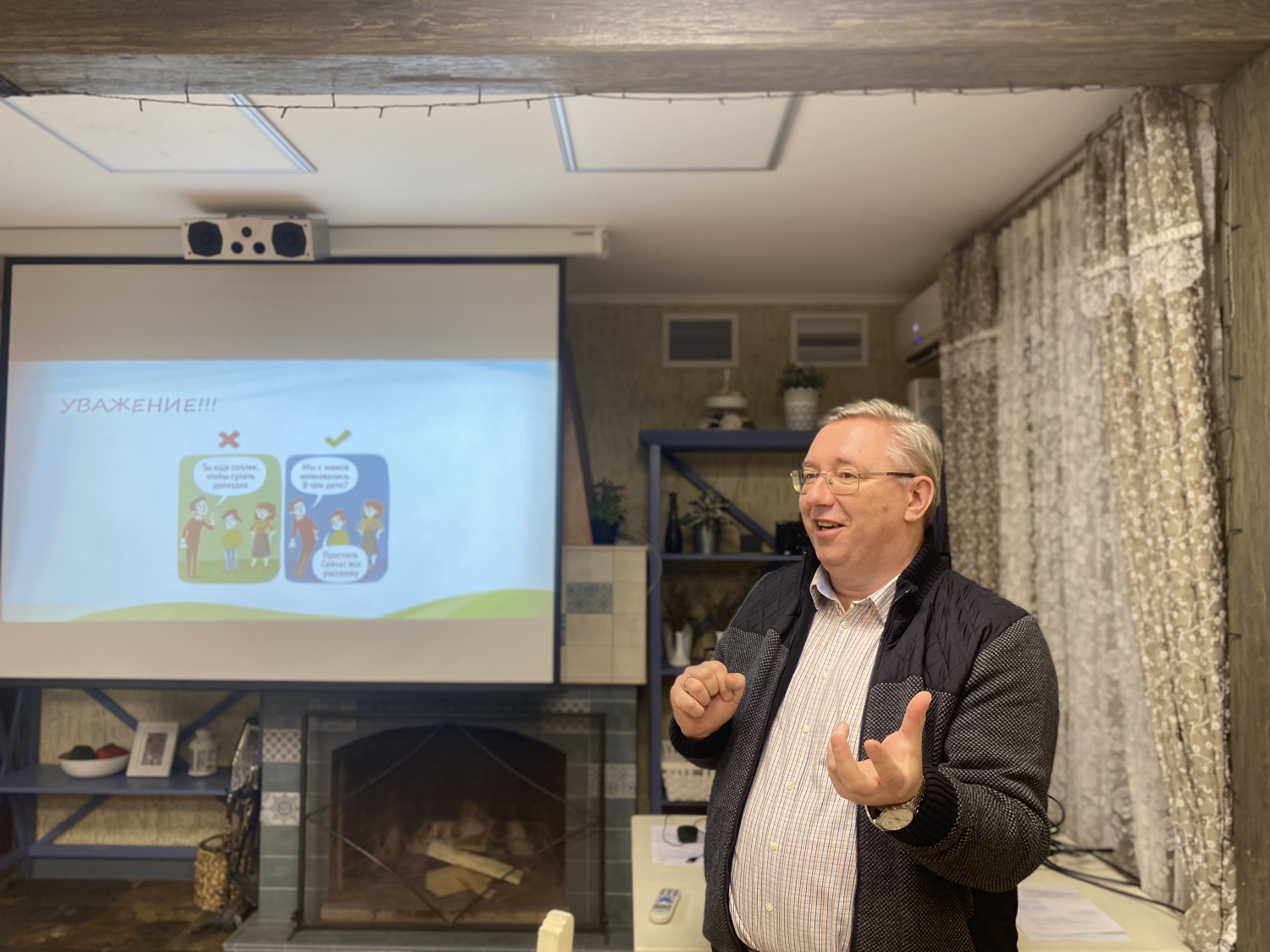
- How was it before? –asked a question Alexei Ananenko, chairperson of CPA "World without Borders".
- If a child is registered in the police, if he has committed a crime, then he should be sent to the prevention council, he should talk to a psychologist and a social pedagogue and then it is necessary to come up with some kind of plan.
Alexei trains specialists of social- pedagogical centers (psychologists and social educators) how to use the following methods in their work “Case management” and “Risk and Opportunity Assessment” (RIA and then he helps to conduct supervision: this is a kind of advanced training, a meeting to analyze difficult cases and help specialists in difficult situations.
- For example, when a class teacher draws up such a plan, he or she thinks: “Let Ivanov do some kind of social work in my class. For example, he can water the flowers. Then I will go home to him once a month and will have conversations with him: for example -in September we will speak about the danger of alcohol, in October – about the danger of nicotine, on New Year's Eve I will talk with him about the danger of firecrackers. And I’ll also check what club he has chosen and if he visits it.” “I don’t visit any clubs,” says Ivanov. “ Oh! Then you are to come to the additional class which I conduct and it will be about the rules of the road,” the class teacher comes up with his/ her idea.
What does the psychologist think about the situation with Ivanov? “I will assess his anxiety, conduct temperament tests, control class attendance, find him a hobby club. In summer we will send him for 10 shifts to a military sports camp.” And everyone who has something to do with Ivanov writes what they can do with this child, based on their own capabilities but absolutely far away from what the child really needs.
We say that there are no bad children, there are bad things that they do. And actions can almost always be corrected. And our task is to convince the child that this should be done.
Our task is not to groan over what has happened, not to give a lecture, but to encourage a child together with a grown up to understand experiences, emotions, feelings, thoughts and other causes of such an act. And in case management there is a step-by-step methodology on how to do this. This is a whole system of sequential actions, from preparation to regular support of a teenager on the way to change.
I use to say while training specialists: “You must understand, you are just advising but that is a teenager who should fulfill what you have planned. You and I, roughly speaking, scratched our tongues and left. And he needs to talk to his mother himself. And at this moment he will be alone to worry about this. And in order to go to school to the classes, he himself needs to sit down and learn a lesson.
We can believe in him, we can support him, but it is He who must act according to our plan.”
Full article here: UNICEFBELARUS
A teenager can be taught to do good deeds
Gallery
Share: